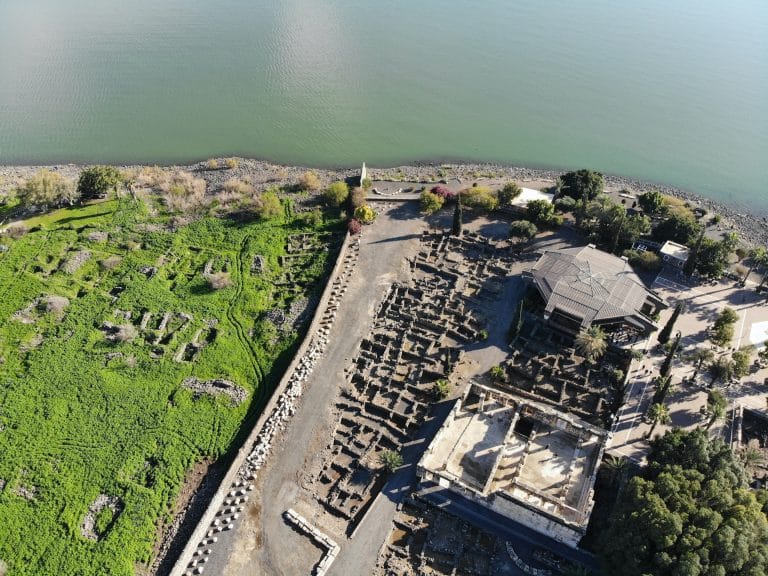
On the eastern shore of the Sea of Galilee, at the foot of the Golan Heights, lies Kursi National Park, one of the most interesting archaeological sites associated with the life of Jesus.
According to Christian tradition, Kursi is where Jesus performed the Miracle of the Swine, casting demons out of a possessed man and into a herd of pigs that rushed into the lake.
Today, visitors can explore the remains of an enormous Byzantine monastery, admire ancient mosaics, walk up to a hillside chapel, and discover some surprisingly unusual local stories.
Although Kursi is considerably smaller and less visited than many of Israel’s famous Christian pilgrimage destinations, it’s a worthwhile stop for travelers interested in biblical history, archaeology, and the fascinating religious heritage of the Galilee.

The Story of Kursi and the Miracle of the Swine
Kursi’s religious importance comes from one of the more unusual stories in the New Testament, known as the Miracle of the Swine.
The story appears in three Gospels: Matthew (8:28–34), Mark (5:1–20), and Luke (8:26–39).
According to the accounts, Jesus crossed the Sea of Galilee and encountered a man possessed by demons. In Matthew’s version, two possessed men are described.
The demons begged Jesus to allow them to enter a nearby herd of pigs. Jesus agreed, and the pigs subsequently rushed down a steep slope into the water, where they drowned.
The Gospels use different geographical names for the area, including the country of the Gadarenes and Gerasenes. Christian tradition has long associated the miracle with the eastern shores of the Sea of Galilee, although its precise historical location remains debated.
Kursi eventually became one of the places most closely associated with this story.
During the Byzantine period, Christians established a large monastery and church here, creating an important pilgrimage destination for believers visiting places connected to Jesus’ life.
Today, Kursi is one of several important Christian holy sites in Israel associated with events described in the New Testament, many of which are concentrated around the Sea of Galilee.
How Was Kursi Rediscovered?
One of the most interesting things about Kursi is that its ancient monastery was discovered almost by accident.
In 1970, workers constructing a road near the eastern shore of the Sea of Galilee uncovered ancient remains.
The discovery led to archaeological excavations during the early 1970s, revealing the foundations of an enormous Byzantine monastery, a church, paved streets, and other structures.
Archaeologists discovered that the complex had been established around the fifth century CE and developed into an important destination for Christian pilgrims.
The monastery suffered significant damage during the Persian invasion of 614, although parts of the complex were subsequently restored. The church was destroyed again during the eighth century, and the area eventually ceased functioning as a major pilgrimage center.
Following excavations and restoration work, Kursi National Park opened to visitors in 1982.
Best Things to See at Kursi National Park
The Byzantine Monastery and Church
The main attraction at Kursi is the remarkably large Byzantine monastery, considered the largest known Byzantine monastic complex discovered in the Holy Land.
Surrounded by a substantial stone wall, the monastery covered an area of approximately 123 by 145 meters.
During its heyday, it was much more than a place of prayer. The complex included living quarters for monks, buildings serving pilgrims, courtyards, agricultural facilities, and other structures needed to support its community.
A paved road once connected the monastery to the nearby shore, allowing pilgrims arriving by boat to reach the complex.
At its center stood a large basilica-style church, measuring approximately 23 by 45 meters.
Although much of the original building has disappeared, the surviving foundations, walls, columns, and reconstructed sections help visitors imagine how impressive the church once was.
The interior was divided into three sections by rows of columns, while a decorated apse marked the eastern end of the building.
Visitors can also see the remains of an ancient baptistery, where an inscription dates the mosaic floor to 585 CE.

The Beautiful Byzantine Mosaics
For many visitors, the mosaics are the most impressive part of the archaeological site.
Several original sections have survived, particularly along the sides of the church.
Look carefully and you’ll discover detailed decorations featuring birds, fish, baskets, flowers, and fruit, including grapes, figs, and pomegranates.
These designs offer a fascinating glimpse into Byzantine artistic traditions and the religious symbolism of the period.
Interestingly, several animal figures were deliberately damaged in antiquity, while many of the plant decorations survived in better condition.
Even if you’re not particularly interested in religious history, the craftsmanship and detail of these ancient floors make them worth examining closely.

The Holy Rock and Hillside Chapel
A short distance uphill from the monastery is another important archaeological site known as the Holy Rock.
During excavations in 1980, archaeologists discovered the remains of a small chapel beside a prominent rock on the hillside.
The chapel incorporated a natural cave, with an apse and several layers of mosaic flooring.
According to Christian tradition, the cave and rock are associated with the place where Jesus encountered the possessed man described in the New Testament.
The structure suggests that the location held particular religious significance for early Christian pilgrims.
Reaching the chapel involves a short uphill walk over uneven ground, so comfortable shoes are recommended.
The elevated position also offers beautiful views toward the Sea of Galilee and the surrounding landscape, making the climb worthwhile even if you’re primarily interested in the scenery.
The Enchanted Bench
Not everything at Kursi is connected to ancient history.
One of the site’s more unusual attractions is a simple wooden bench known as the Enchanted Bench.
Over the years, the bench has developed a reputation among visitors for creating an unusual feeling of calm and relaxation.
Some believe that sitting here brings positive energy, while others associate the location with spiritual experiences or personal wishes.
There is no scientific evidence that the bench possesses unusual powers, but the stories surrounding it have become part of Kursi’s modern identity.
Whether you believe in its supposed powers or not, it’s an interesting little stop and a peaceful place to rest during your visit.
The Sand Scripture Activity
Another unusual attraction at Kursi is an interactive installation featuring a rotating drum and a sandbox.
Visitors can turn the drum to imprint passages from the New Testament’s account of the Miracle of the Swine into the sand.
The activity offers a different way to connect the archaeological site with its biblical story.
It’s also a welcome interactive element for families visiting with children, especially after exploring the monastery’s ruins.
The Ancient Bathhouse
Archaeological excavations between 2011 and 2013 uncovered the remains of an ancient bathhouse north of the church.
The discovery provides another glimpse into daily life in the area during the Byzantine period.
Bathhouses served important social and practical functions in ancient communities, and their presence helps demonstrate that Kursi was once a developed settlement rather than simply an isolated religious building.
Although the remains are less visually impressive than the monastery or mosaics, they add another interesting layer to the history of the site.
Places to Visit Near Kursi
Kursi’s location on the eastern side of the Sea of Galilee makes it easy to combine with several other historical and religious attractions in northern Israel.
One of the most important is Capernaum, an ancient fishing village on the northern shore of the lake, closely associated with Jesus’ ministry. Visitors can explore impressive archaeological remains, including an ancient synagogue and early Christian religious sites.
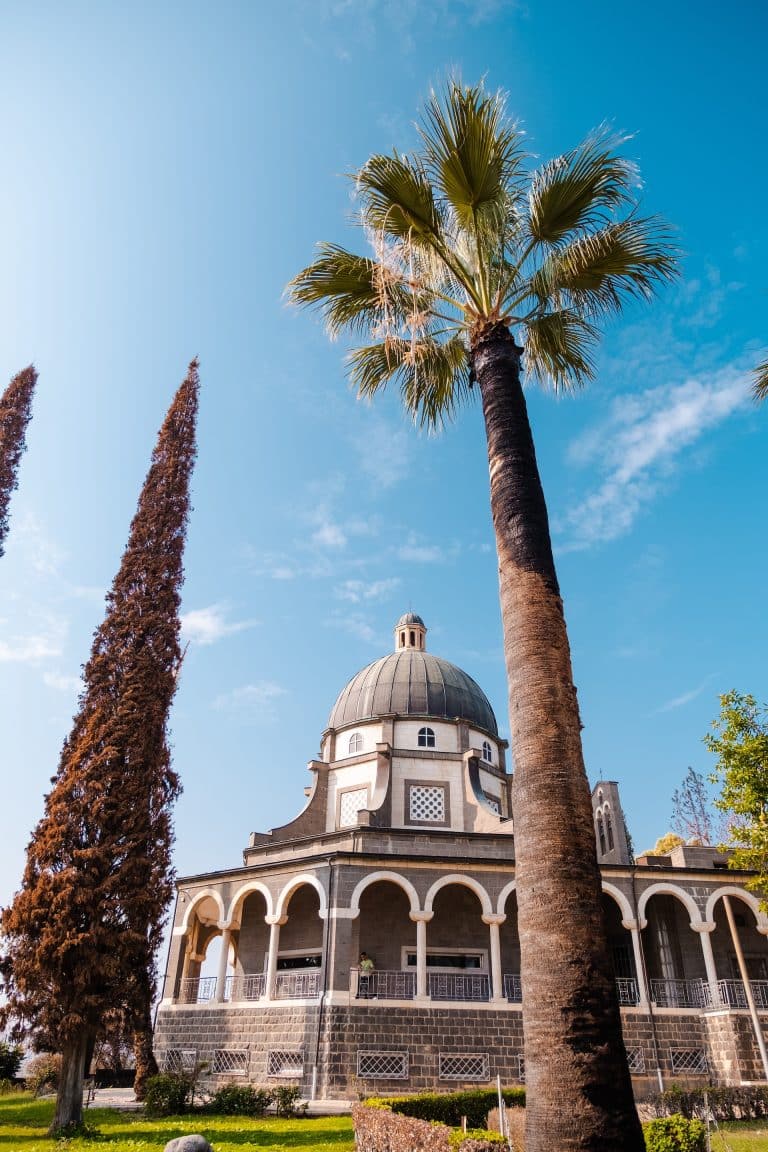
Another interesting stop is the Mount of Beatitudes, traditionally associated with the Sermon on the Mount. The hilltop church and surrounding gardens offer beautiful views across the Sea of Galilee, making it a peaceful place to visit.
For travelers interested in exploring the places connected to Jesus’ life on foot, the Jesus Trail is another fascinating option. This multi-day hiking route connects Nazareth with Capernaum, passing through several significant biblical locations and beautiful landscapes.
If you’re spending more time in northern Israel, our guide to the Galilee includes additional historical sites, nature reserves, viewpoints, and hiking opportunities.
Together, these destinations make it possible to plan an entire day, or even several days, exploring the history and landscapes surrounding the Sea of Galilee.
Planning Your Visit to Kursi National Park
How Long Should You Spend at Kursi?
Most visitors will find that around 45–60 minutes is enough to explore the monastery, church, and main archaeological remains.
If you’d also like to walk up to the Holy Rock, examine the mosaics closely, and take your time enjoying the surroundings, we’d recommend allowing around 1–1.5 hours.
Kursi is relatively compact, making it a convenient stop during a longer day exploring the Sea of Galilee.
Opening Hours
Summer:
Sunday–Thursday and Saturday: 08:00–17:00
Friday: 08:00–16:00
Winter:
Sunday–Thursday and Saturday: 08:00–16:00
Friday: 08:00–15:00
Last admission is one hour before closing. Shorter hours may apply on holiday eves, and special arrangements may apply during holidays.
We recommend checking the Israel Nature and Parks Authority website before visiting.
Entrance Fees
Adult: 16 ILS
Child: 7 ILS
These are the standard admission prices published by the Israel Nature and Parks Authority and may change.
How to Get to Kursi
Kursi National Park is located on the eastern side of the Sea of Galilee, near the southern foothills of the Golan Heights.
If you’re driving along Road 92, turn east at Kursi Junction, approximately 5 kilometers